Most budgets fail in the same place. Rent, utilities and the phone bill are easy to plan because they show up every month at roughly the same amount. Then the car registration arrives, or the kids need school supplies, or a birthday falls in a week when money is already tight. None of these are surprises, exactly. They just don’t happen monthly, so they never make it onto the plan.
These are irregular expenses, and learning to plan for them is one of the most useful money skills there is, especially when there isn’t much room between what comes in and what goes out.
Step 1: List the costs that don’t come every month
Sit down with last year’s bank statements, a calendar, or just your memory, and write down every cost that happens once, twice or a few times a year. Common ones include:
- Vehicle registration, inspection and insurance premiums paid twice a year or annually
- Car maintenance: oil changes, tires, brakes
- School supplies, field trips and activity fees
- Birthdays, holidays and other gifts
- Medical and dental visits, prescription refills and eyeglasses
- Annual subscriptions, memberships and renewals
- Household replacements like a vacuum, a mattress or kitchen basics
- Clothing and shoes as kids grow
Don’t worry about being exact on the first pass. A rough list beats no list. You will refine it as the year goes on.
Step 2: Turn yearly costs into monthly amounts
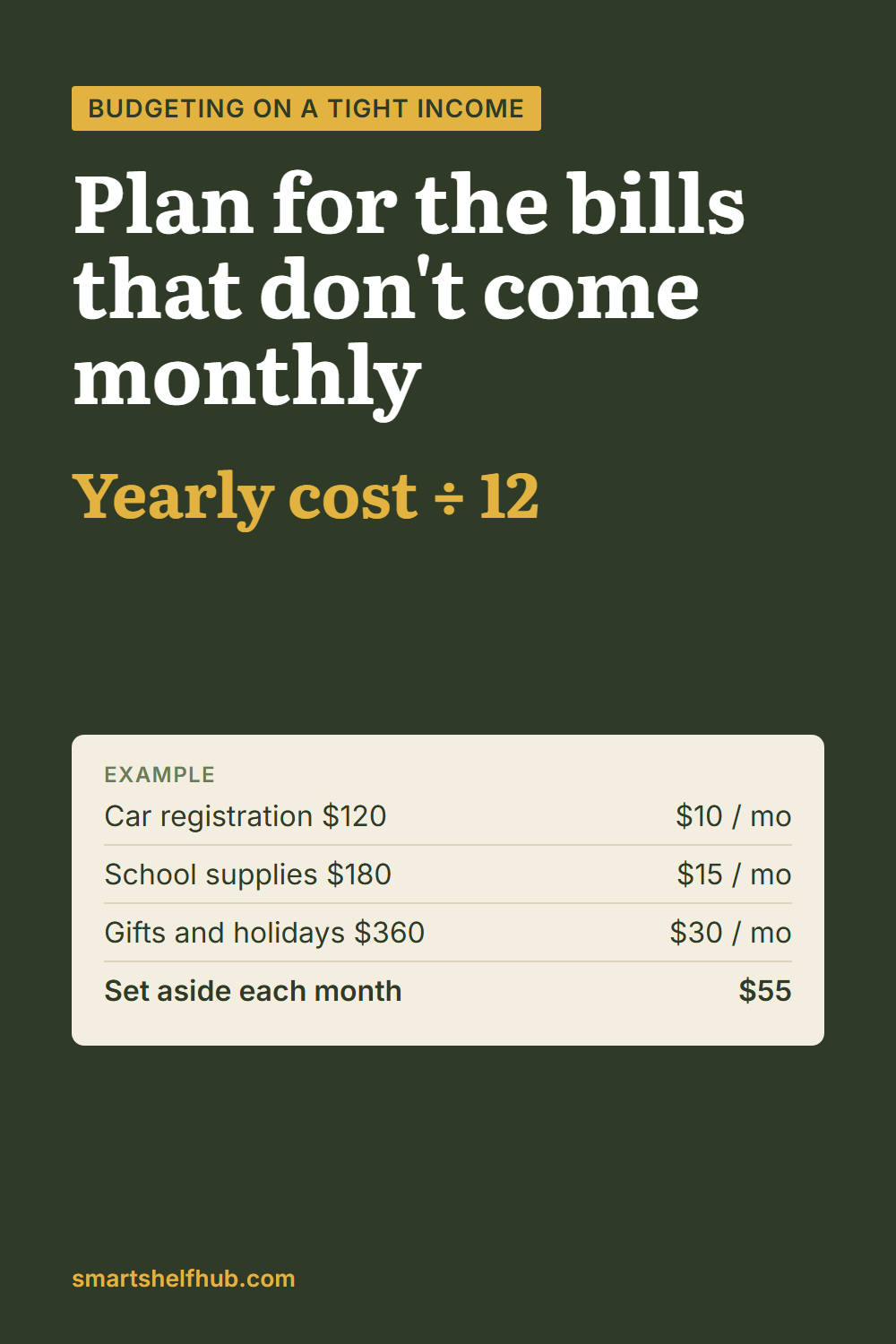
For each item, estimate what it costs in a year, then divide by 12. That gives you a small monthly amount to set aside so the full bill is covered when it arrives.
Here is a made-up example to show the arithmetic:
- Car registration: $120 a year ÷ 12 = $10 a month
- School supplies: $180 a year ÷ 12 = $15 a month
- Gifts and holidays: $360 a year ÷ 12 = $30 a month
- Car maintenance: $300 a year ÷ 12 = $25 a month
In this example, setting aside $80 a month means four bills that would each have caused a scramble are already covered. Your numbers will be different, and that is fine. The method is what matters.
If a cost happens twice a year, divide the yearly total by 12, not each payment by 6. Keeping everything on the same 12-month basis makes the totals easy to add.
Step 3: Be honest about what fits
Here is where many budgeting guides stop being realistic. Adding up every irregular cost can produce a monthly number you simply can’t afford right now. If that happens, it isn’t a personal failure. It is information.
When the total doesn’t fit, rank the items:
- Costs with consequences if missed: registration, insurance, medication. Fund these first.
- Costs you know are coming but can shrink: gifts, holidays, school extras. Set a smaller amount and a smaller plan.
- Costs that can wait: replacements and upgrades. Note them so they don’t disappear, but fund them later.
Starting with even one or two items is real progress. Each one you cover is one less emergency on your calendar.
We cover budgeting on a tight income step by step in A Realistic Budget for Living Paycheck to Paycheck
Step 4: Keep the money where you won’t spend it by accident
Money set aside for next spring’s registration looks a lot like spare money in March. Some ways to keep it separate:
- A second savings account at your bank, named for its purpose if your bank allows it
- Labeled envelopes for people who prefer cash
- A simple running list in a notebook or spreadsheet that shows how much of your balance is already promised
Pick whichever you will actually keep up. A simple system you use beats a perfect one you abandon.
Step 5: Watch the timing, not just the totals
A budget can balance for the month and still leave you short in a particular week, because paydays and due dates don’t line up. Write your paydays and your bigger due dates on one calendar. You may find that moving a transfer to the day after payday, rather than the end of the month, keeps you from dipping below zero before the next deposit.
Step 6: Use the money, then rebuild
When the registration bill arrives and you pay it from the money you set aside, the system worked. The fund is supposed to go down. Start setting aside the monthly amount again from the next paycheck.
Once or twice a year, check your list against what actually happened. Did the car need more than you planned? Did a cost disappear? Adjust the monthly amounts and keep going.
Common questions
Is this the same as an emergency fund? No. Irregular expenses are predictable: you know they will come, even if not exactly when. An emergency fund is for things you can’t predict, like a job loss or an unexpected repair. Keeping them separate shows you which one you are really using.
What if my income changes every month? Plan your set-asides around a careful, lower estimate of income. In better months, add a little extra to the items most likely to be underfunded.
What if I can’t set anything aside right now? Then make the list anyway. Knowing what is coming and when lets you plan the order of bills and talk to providers early, which is still better than being caught off guard.
This article is general financial education, not individual financial advice.