If you have started lifting weights, you have probably heard that you need “progressive overload” to keep getting stronger. The idea is simple: over time, ask your body to do a little more than it did before. The hard part is knowing when to add more, how much, and what to do when you can’t.
This guide explains a straightforward approach many beginners use, called double progression, along with the effort and recovery habits that make it work.
What progressive overload actually means
Your muscles adapt to the work you give them. Once a weight feels routine, it stops being much of a challenge. Progressive overload means gradually increasing the challenge so your body keeps adapting. You can do that in several ways:
- Lifting more weight
- Doing more repetitions with the same weight
- Doing more sets
- Improving control and range of motion on the same movement
For most beginners, the simplest options are the first two: more reps, then more weight.
Double progression, step by step
Double progression uses a repetition range instead of a fixed number. Here is how it works with an example range of 8 to 12 reps:
- Pick a weight you can lift for at least 8 good repetitions on each of your sets.
- Add reps over the following sessions. Next time, try for 9 or 10 on some sets. Keep the weight the same.
- Reach the top of the range. When you can do 12 good reps on every set, the weight has become too easy for this range.
- Add a small amount of weight and drop back toward 8 reps. Then start climbing again.
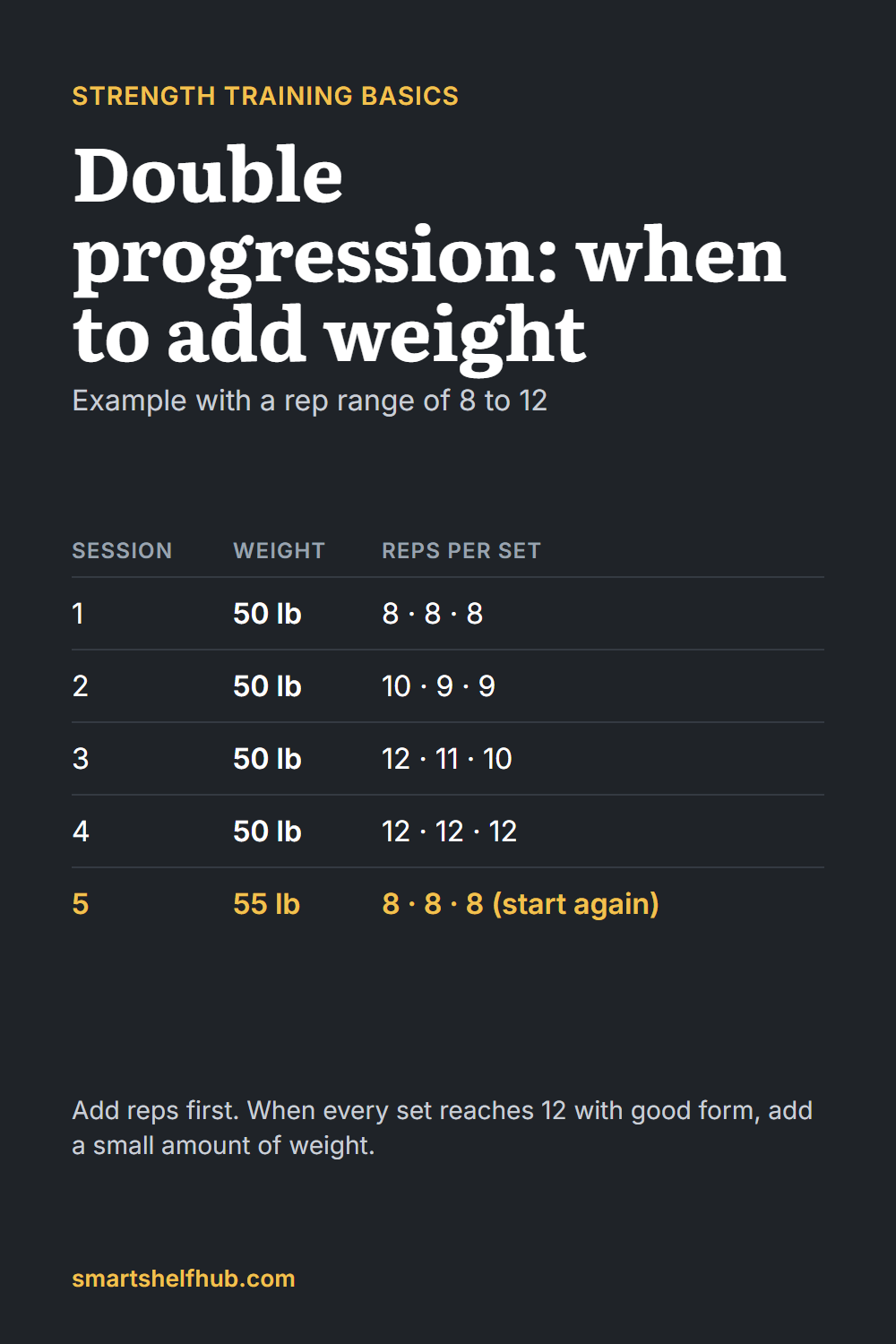
Progress comes in two directions, reps first and then load, which is where the name comes from. It is easy to track, it builds in small steps, and it tells you exactly when to add weight instead of guessing.
Keep the jumps small
The most common beginner mistake is adding too much weight too soon. If the next available jump is large (some machines and dumbbell racks jump in big increments), you have options:
- Stay at the current weight and add a rep or two beyond the top of your range before moving up
- Add the weight to just one set first, then the others in later sessions
- Use smaller plates if your gym or home setup has them
Form comes first. If the extra weight changes how you move, it isn’t progress yet.
How hard should each set feel?
You don’t need to go to complete failure on every set to make progress. A useful way to judge effort is “reps in reserve”: at the end of a set, how many more good reps could you have done?
Many lifters aim to finish most sets with about one to three reps left in reserve. That is challenging enough to drive progress while keeping your technique intact and your recovery manageable. If you finish a set and could clearly have done six more, the set was too easy. If your form fell apart on the last reps, it was too hard.
Rest between sets
Rest long enough that you can perform well on the next set. For bigger movements like squats and rows, that often means a couple of minutes. Shorter rests feel efficient but can cut your reps on the following sets, which slows the progression above.
Write everything down
Double progression only works if you know what you did last time. After each session, record the exercise, the weight, and the reps for every set. A notebook or a notes app is enough. Without records, most people either repeat the same workout for months or jump ahead too fast.
Your log also tells you when something is wrong. If reps stall or drop for two or three sessions in a row, look at sleep, stress and how well you are eating before changing the whole program.
Blank workout logs and a 12-week calendar are included in A Simple Strength and Muscle-Building Program
When progress stalls
Stalls are normal, especially after the first few months. Before making big changes, check the basics, then change one thing at a time:
- Are you sleeping and eating enough to recover?
- Are you resting long enough between sets?
- Are your jumps in weight too large?
- Has your form changed?
If the basics are fine, a small change such as adding a set or adjusting the rep range is usually enough. Changing everything at once makes it impossible to know what helped.
Recovery is part of the program
Muscles get stronger between sessions, not during them. Rest days, sleep and regular meals are part of training. Soreness isn’t a reliable sign of a good workout, and feeling exhausted after every session usually means you are doing more than you can recover from.
This article is general education, not medical or coaching advice. If you have an injury, a medical condition or any concern about exercising safely, talk to a qualified professional before starting.