If your week tends to start with good intentions and end with a list of things that didn’t happen, a more detailed schedule is probably not the fix. Detailed schedules break the first time a meeting runs long or a kid gets sick, and then the whole plan feels useless.
What works better for most people is a short, repeatable routine: about 20 minutes once a week to look at what is coming, decide what matters, and leave room for the things you can’t predict. Here is one way to do it.
Pick a time you will actually keep
Sunday evening and Monday morning are the most common choices, but any time works if it happens before the week gets going. Put it on your calendar like an appointment. Keep it short on purpose. A routine that takes two hours is one you will skip.
You need very little: a calendar (paper or app), a notebook or planning page, and your list of open tasks wherever it currently lives.
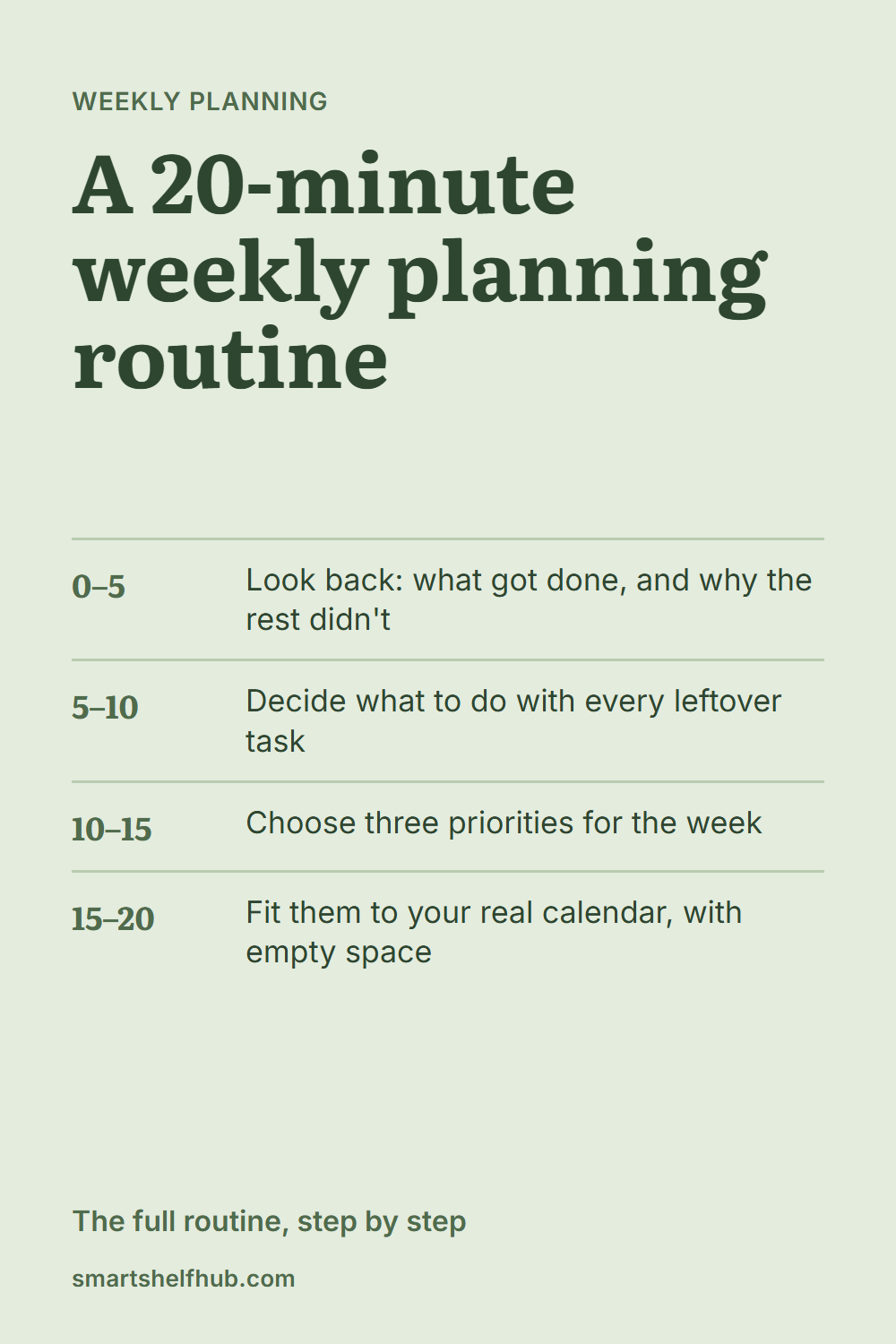
Minutes 1–5: Look back at last week
Before planning forward, spend a few minutes on what just happened. Ask two questions:
- What got done? Write down a few things, even small ones. This keeps you from feeling like nothing happened.
- What didn’t, and why? Was the task unclear, too big, interrupted, or not actually important?
The “why” matters more than the list. If the same kind of task keeps slipping, that is useful information for this week.
Minutes 5–10: Deal with the leftovers on purpose
Unfinished tasks are where most planning systems quietly fall apart. They roll forward week after week until the list is too long to look at. Instead, make a decision about each leftover:
- Carry it forward if it still matters and you can realistically do it this week.
- Shrink it to a smaller next step if it has been stuck because it is too big.
- Schedule it later if it matters but not now.
- Hand it off if someone else can do it.
- Drop it if it no longer matters. This is allowed.
Write the tasks you are carrying forward in one short list where you will see them.
Minutes 10–15: Choose three priorities
Look at the week ahead and pick no more than three things that would make the week feel successful. They can be work, family or personal. One might be “finish the report,” another “book the dentist,” another “two evening walks.”
Three is a deliberate limit. Most weeks already contain plenty of required tasks. The priorities are the things that won’t happen unless you protect them.
Minutes 15–20: Fit the week to your real calendar
Now look at the actual days. Mark appointments, deadlines and fixed commitments first. Then look honestly at the time that is left and place your priorities and carried-forward tasks where they fit.
A few habits help this step:
- Plan by energy as well as time. Put demanding tasks where you are usually sharpest, and easy tasks into tired evenings.
- Leave empty space. If every slot is full, the first interruption knocks everything over. Unplanned space is what absorbs the week’s surprises.
- Be specific. “Call the insurance company Tuesday at lunch” is far more likely to happen than “insurance.”
During the week: adjust, don’t restart
Interruptions are guaranteed. When one comes, you don’t need to rebuild the plan. Ask one question: “What is the next most important thing I can still do today?” Move one task, not the whole week.
If a day goes completely off the rails, let it. Look at the plan again the next morning and pick up from there.
We cover choosing priorities and recovering from interruptions step by step in A Weekly Planning Routine That Sticks
At the end of the week
The look-back step at the start of next week’s session is your review. Over a few weeks, patterns will show up: tasks you always underestimate, days that are always overloaded, priorities that keep slipping. Small adjustments to those patterns do more than any new app.
If you share a household
When other people’s plans affect yours, add five minutes to compare calendars with them. Look for the collisions first: two appointments at the same time, a late meeting on the night someone needs a ride, a deadline in the same week as a school event. Agree on who handles what before the week starts. It is much easier to sort out on Sunday than at 5 p.m. on a Wednesday.
If kids are old enough, let them add their own events. It saves you from being the only person who remembers everything.
Signs the routine is working
- Your leftover list stays short instead of growing every week
- You know on Monday what matters most this week
- An interrupted day doesn’t wreck the rest of the week
- You are finishing your weekly session in about 20 minutes
It won’t make every week perfect. The goal is a routine you can come back to even after a week that didn’t go to plan.